Have you recently gotten stuck with an audit or inspection on your insurance policy?
Does it seem like your insurance company is getting aggressively demanding lately?
Are you getting cancel notices or big non-cooperative audit fees because you didn’t comply?
OK, that’s a lot of questions. But if you have had any of these, this article is for you. In it, we are going to discuss audits and inspections: what is going on in the insurance market that is causing this uptick and what you can do about it.
So here’s what’s going on: In the last few years, insurers have been conducting more audits and inspections on their policy holders than they did in the past. While audits and inspections have always been a right reserved by the insurer on any policy they issued, they didn’t always act on that right. But now, insurers are acting on that right much more frequently. So if you haven’t gotten one, you probably will. Whatever policy you have; workers comp, property, general liability, pollution, employment practices, and even business auto – yes, business auto – is subject to your insurer, contacting you to set up an audit or an inspection.
This begs the question: why? Why all the audits and inspections lately?
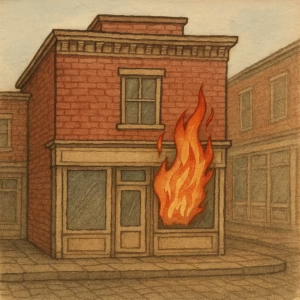
Let’s start with the root cause: Fire. Specifically wildfires that result in insurance claims. Burned down buildings. Without going into too much detail – and there is a lot of detail – wildfires are main driver of the change in the insurance market. I wrote a blog about it a couple years ago and you can check it out here if you want.
Fires have changed the insurance market from a competitive soft market to an uncompetitive hard market.
What is a hard and soft market?
A soft market is when the market is good. Insurers are profitable and they compete for your business by lowering rates, offering a broader array of coverages, and make it easy to qualify. More insurers jump into the market to grab that market share which gives you a wide variety of insurance options to pick from.
A hard market, on the other hand, is the just the opposite. The market is bad. Insurers are not profitable, and they do whatever they can to make sure that the policies they have on the books, whether existing or new (if they choose to write new business at all) will make or keep them profitable. Those insurers that venture into the market raise rates and reduce coverage. Their policies often have more exclusions and limitations. They may have higher deductibles. They may even offer less flexible payment options requiring you to pay more money up front.
And, in a hard market, they tighten up their underwriting guidelines. They make it harder to qualify. They do what they can to reduce losses. They verify the accuracy of the information their policy holders tell them, and they do it through audits and inspections, which takes us to the main point of this video.
What actually are audits and inspections?
An audit is when the insurer kindly asks (demands) that you, the policyholder, provide the information or documentation to cross reference it with the information you gave them at the beginning of the policy period. They want to know if the numbers you provided when you started your policy are correct or if they need to be changed. The purpose of an audit is to charge accurate premium based on the size of your business. In order to do that, you show them the numbers. For example, on a workers comp policy, they will verify if the payroll you provided is correct. If it’s a general liability policy, they’ll verify if the annual gross revenue you provided to them is correct. If you’re a contractor, they will want to know about subcontractors you’ve used and if you’ve collected certificates of insurance from them.
An inspection is where the insurer takes a look at that thing you’re insuring, whether it’s your place of business, or the building or item you’re insuring, to make sure it is insurable condition, safe, up-to-code, and doesn’t create any unforeseen hazards or surprises. It can be a virtual inspection using mapping software, or they may send a person to come out physically look at the location, building, or other item. The purpose of the inspection is risk management: to reduce the chance of a claim occurring. What do they look for? Things that can lead to claims. For example, they’ll check on the condition of the property. They’ll check for cracks in the pavement, broken windows, expired fire hydrants, out of date Ansul systems if you’re a restaurant, debris laying around, and other trip hazards, unrepaired damage, conditions that can lead to damage, and more. They’ll even look at the condition of the other locations surrounding your location.
So now that I’ve explained what is happening and why, let’s look at what we can do when faced with an audit or inspection to make it go over as smooth as possible.
The first thing is, you need to comply. You can’t ignore an audit or inspection request. We know this is not something that you probably want to hear. Many long time policy holders are surprised or offended when they get the notice. Others feel like it’s a waste of time. They’ve never had to deal with an audit or inspection in the past, so why should they now? But, if you don’t comply with the audit or inspection, you’ll find yourself with one of the following outcomes:
- Non-compliant surcharge in the case of an audit, which often doubles the premium. Non-compliant surcharges are common in workers comp, but it’s happening in other lines of business too, like general liability.
- Midterm cancellation.
- Both
Every audit and inspection has a deadline. Inspections will often have mandatory recommendations. So make sure you complete these things on time.
Second, the auditor or inspector will reach out to you. They usually won’t be someone from your insurance company. They will come, typically, from a third party administrator that your insurer hires, so you will probably not recognize the company. They will call or email you. This is pretty basic information, so why am I talking about it? Because in an era of spammers and fraudsters, and mass over-communication, people don’t answer their phones or read their emails unless it is someone that they already know. Over the last few years, in this agency, we’ve seen an unprecedented number of calls from the insurer telling us agents that the policyholder is non-responsive. So, our advice is to slow down when deleting emails and voicemails and pay attention to the fact that an auditor or inspector representing an insurance company may be trying to reach out to you.
When should you expect to hear from them? They can contact you at any time during the life of your policy. But inspectors typically reach out right after your policy inception, and auditors reach out right after your old policy’s expiration, which is ironically the same time period. So you may be hearing from two separate people at the same time: the inspector for your new policy and the auditor on your old policy.
Third: note that your insurance agent does not initiate, conduct, or set up your audits or inspections. If you have a good agent, he or she is there to advise and advocate on your behalf as well as facilitate communication between you and the auditors/inspectors if needed. That’s what we do at Gillespie Insurance Services.
Also note that agents don’t have the ability to override, reduce, eliminate, or cancel an audit or inspection. How a good agent can help is if something doesn’t look right. Your policy jumped from $2,000 to $18,000… what went wrong? Did you send the right form? Did you make a mistake in your reporting? Did the inspector not receive your email? Unusual activity or massive mandatory recommendations required in a short amount of time is usually when an agent gets involved. Use your agent for these types of things: help, guidance, advice, oversight.
Those are my three tips. If you follow my advice; pay attention to your communication devices, act promptly, and comply with the insurer recommendations, you’ll do just fine. And use your agent as resource to help you along through the process.
In closing, it is possible that this era of mass audits and inspections will come to an end, although I wouldn’t expect it too soon. It is in the hard market when these insurer-induced heavy-handed actions exist and it is in the soft market when they tend to go away somewhat. But the future is unknown and there are lots of factors that play into why an insurer takes the actions it takes.
Lastly – if you are looking for any advice or need help on your audit or inspection, or if you’re looking for a quote on any property and casualty policy, whether it be workers comp, property, general liability, our auto, please reach out!
Here’s our super-simple three-step process.
- Set an appointment. Just click HERE
- Have a conversation. We’ll learn about you and your business, gathering all the information needed to offer you audit or inspection guidance, or an insurance quote.
- We’ll present you with a solution and/or quote depending on your needs.